
🧭 Overview
Color: 🔴
Competitiveness: 🔥🔥🔥🔥🔥
Difficulty: 🧠🧠🧠
Type: 🏹
Tempo: 🐇
🎯 Strategy
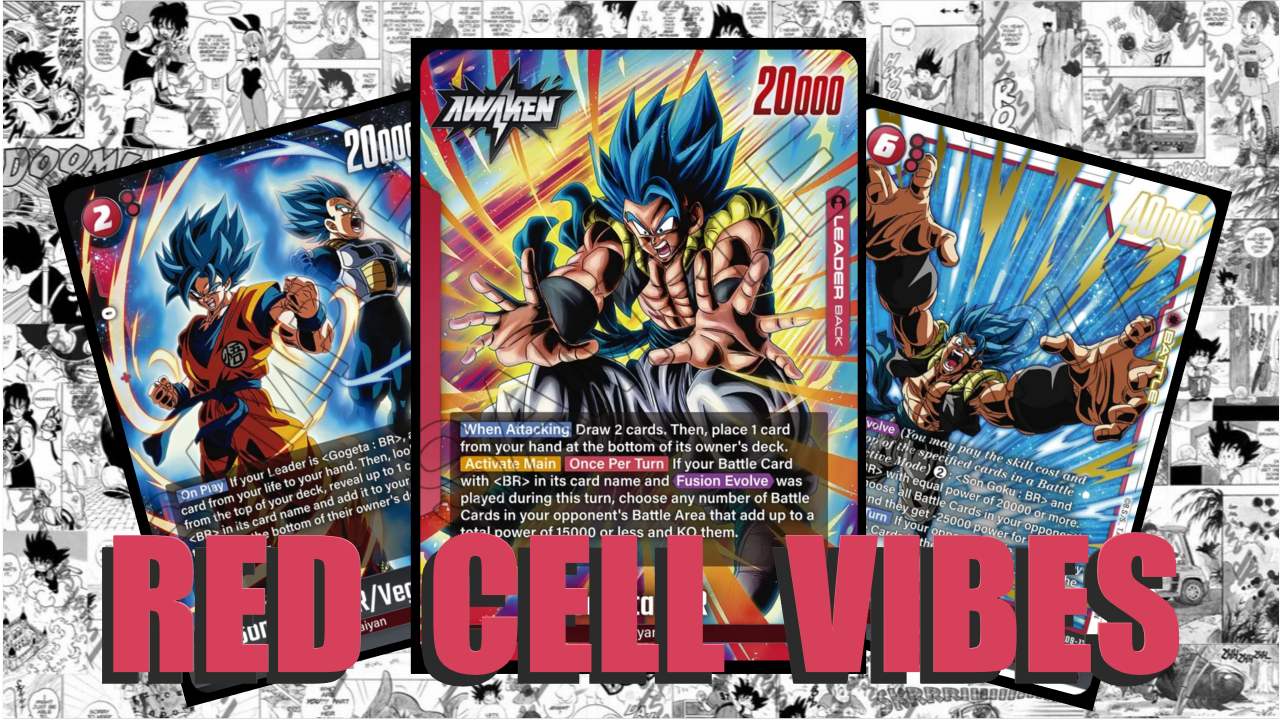
This deck is very similar to Red Cell, just a slightly reworked and supercharged version of it. The basic concept behind our sequencing is identical: there is a card that attacks and potentially draws a card, which evolves into another card that attacks, followed by an even bigger card coming down to attack again (except here, the first two phases are identical and can run parallel). Meanwhile, the opponent's board gets completely decimated, often without direct attacks into their battle cards. Even more so here, because the leader itself handles the board instead of hitting like a truck.
Where things change is that with Cell, the game primarily began at 4 energy. Everything before that was just setup. In contrast, Gogeta can potentially start attacking with its 2-cost cards right away. If the opponent fails to remove them, our big payoff sequence starts much earlier than expected, making us a threat every single turn from turn 2. Another critical improvement is that while Cell's strategy revolved entirely around a single card line, here we have multiple viable options, making our playstyle vastly more flexible. We can attack twice, clear the board in various ways, or if we prefer, we can just bank our resources and squeeze pure value out of our turn. Finally, even if they manage to clear our board, we have Cheelai to cheat out combinations that we wouldn't normally be able to afford with our current energy pool.
Because of this, there is no hard-coded winning strategy. We must constantly adapt to our opponent's actions and commit to whichever sequence yields the highest value. The only general rule is to remain active and try to extract the absolute maximum from every single turn along the energy and attack axis. If we don't pressure the opponent's life total, our SCR won't be threatening on the board, and therefore, we cannot commit to a purely control-oriented playstyle. In the vast majority of cases, our path to victory will go through the SCR, which essentially functions as an alternative double strike threat.
⚠️ Challenges
The only real bottleneck for this deck is if we get incredibly unlucky and fail to draw our core pieces early on, causing our engine to stall out. Because this deck relies so heavily on the evolve mechanic, we constantly need 2 or 3 specific cards in hand to stay on an optimal curve.
However, bad card draw isn't the only thing that can disrupt our game. This is not a simple deck in the sense that it grants us a much higher degree of freedom than average, which can lead to analysis paralysis for players who aren't used to this style of play. Most of the time, if it feels like the deck is underperforming, it is usually the result of non-optimal decision-making rather than the deck itself.
🧱 Core Cards
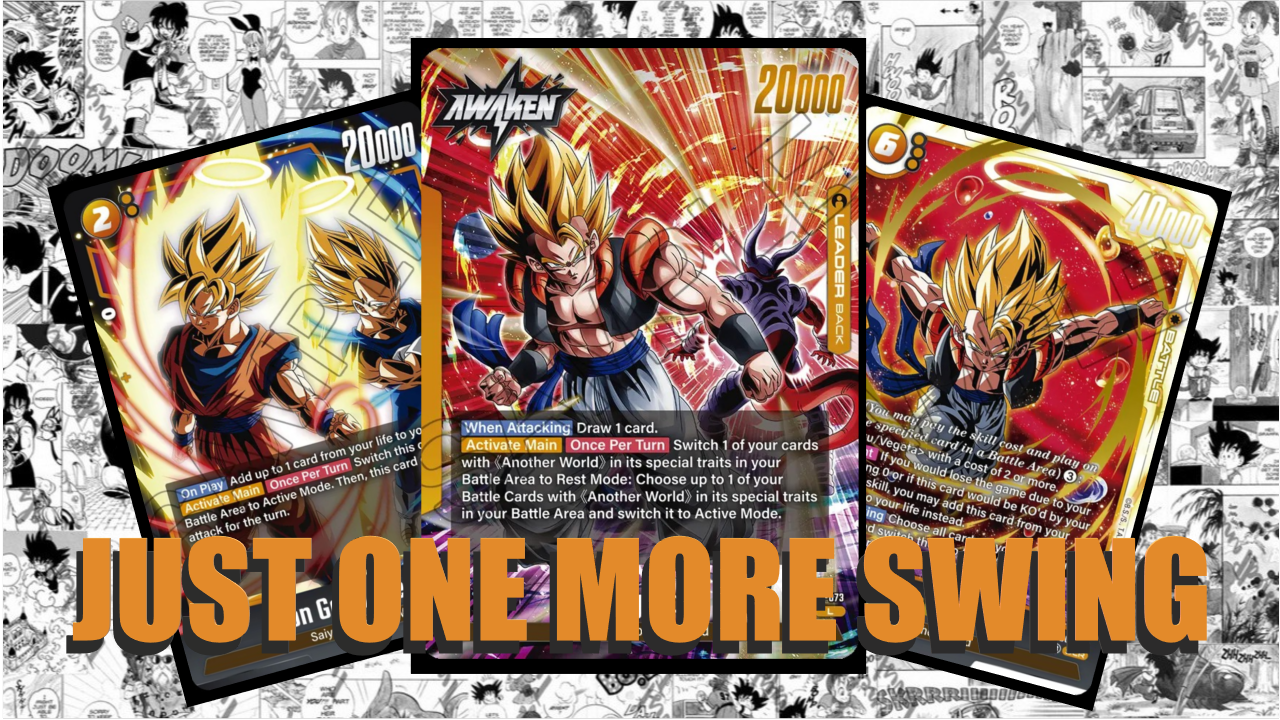
FB09-121 Gogeta: BR – The signature card of the deck, board clear and alternative win condition.
FB09-011 Son Goku: BR/Vegeta: BR – The foundation of consistency and the main reason room for maneuver is so massive.
FB09-012 Cheelai – The core of your flexibility, thanks to her, we can pull off almost anything from 4 energy onward.
💡 Tips
Never underestimate Veku. If the opponent has no board presence, he is a fantastic option for the early game. Additionally, after dropping Vegeta, Veku will also get a meaningful swing.
Try to map out your Evolve processes in a way that allows you to wipe the opponent's board every turn using your Leader ability alone, without wasting extra attacks on their cards.
Do not over-extend with Cheelai. While it's true that you gain 1 energy for every Cheelai you play during a turn, you also lose an attack in the process.
The SCR is not always the best solution. The deck is highly flexible, so build toward whichever high-cost cards brings you the most value in that specific turn.
If you are familiar with your opponent's deck and game plan, a well-timed Promo Gogeta can completely sabotage their entire upcoming turn.
⚙️ Fine-Tuning
Additional Cards
FS01-16 God Kamehameha: An alternative removal option, which one you run is highly meta-dependent.
FB09-018 Vegeta: A superb choice if you want to push for the fastest possible awakening.
Ratio Adjustments
FB09-006 Gogeta: BR: Can easily be bumped up to 4 copies if you find yourself using it frequently.
FB08-008 Goten: I personally like this card a lot, but it can be dropped in favor of running more archetype-specific cards.
📈 Meta
Cards
FB03-026 Sphere of Destruction: Excellent in the mirror match as well as against yellow. Clears almost any early-game threat.
Matchups
As an experiment, I am trying to provide more concrete advice against specific leaders. I chose the two most popular decks to test this format. Any feedback will shape the future of this section.
VS SS3 Goku
In this matchup, board control plays a smaller role because you will usually face a near-empty board. Most of the time, your opponent won't dare leave cards with over 20k power standing, which elevates the importance of your 5-cost Gogetas and the 6c Promo. With the latter, you can practically guarantee that your opponent won't be able to kill you on the following turn, since they won't be able to use extras cost-effectively and will want to commit as few cards as possible.
Some players utilize the Top field, but I personally don't like that card. I would rather avoid using Cheelai here to ensure we don't lose out on attacks. I wouldn't intentionally take life from my own cards unless it's strictly necessary to force awakening or handle the board.
VS Brogeta
In the mirror match, maximizing your value is everything, as absolutely anything on the board can be cleared with ease. Your objective is to swing into the opponent's leader while consistently wiping their board via card abilities. The 5-cost cards can be answered by almost anything, while their 6-cost threats are cleared away by your SCR. Veku is exceptionally useful here because your cards aren't going to stick around anyway. Strive to swing as much as possible and try to lose the absolute minimum amount of cards from your hand.
🎥 Gameplay
Digital
FB09
Free
6899c481-85b5-4e15-b1bc-645411290aa0 - kiogeta; gold
bc3c33df-0128-4341-a95c-d7eb7c085691 - janemba; platinum
20e62ad5-91e4-4361-90a3-8710afde8ca5 - ss3ku; god (youtube)
Ranked
6cc68088-b8a5-4232-9361-c41fe104a7cd - kiogeta; platinum
0bd19161-8667-4c43-9198-5cf02bc94994 - brolybr; god (youtube)
27c1e43b-12aa-4c0f-902c-a613356b1acb - kiogeta; platinum (youtube)
cfec03e4-e324-48bc-8b1c-17ee49c1c381 - kiogeta; god (youtube)
93cdab4a-8b49-4a39-998a-62e231b4d82d - muiku; god (youtube)
Youtube
📃 List
💬 Personal Notes
I firmly believed this deck would be the BDIF (Best Deck in the Format) for FB09. My logic was simple: we had Red Cell, who completely dominated the meta for seasons until he ultimately had to be banned, and then they introduced a new iteration of that engine that is more active, faster, more flexible, and comes with a dedicated finisher. It had everything it needed to succeed. I don't think I was far off, as I consider it the second strongest deck in the format, and it could easily contend for the BDIF title again in FB10 thanks to the revealed support (which, in my personal opinion, it didn't need whatsoever).
As far as my personal preferences go, I find this to be a highly enjoyable deck. I only avoided it initially because I don't like playing the big boogeyman decks of the format, as it makes winning feel less rewarding and forces me into too many mirror matches. That being said, there is a night-and-day difference in performance when this deck is in the hands of a great player versus a mediocre one. The sequencing, the decision-making, the mini mind games regarding what you reveal versus what you actually commit to the board, and the math required to cleanly wipe the entire board every single turn make for a fantastic gameplay recipe that I will happily play any day.
🔑 Legend
Icons
Type: 🗡️ Aggro | 🏹 Midrange | 🛡️ Control | 🔗 Combo
Tempo: 🐌 Slow | 🐇 Medium | 🦅 Fast
Difficulty
🧠: Beginner-friendly, perfect even for your first game.
🧠🧠: Easy; requires attention to a few small details, but follows a simple and clean strategy.
🧠🧠🧠: Requires learning, but becomes routine after sufficient practice.
🧠🧠🧠🧠: Requires a deep knowledge of both your own deck and the opponent's; demands situation-dependent decision-making.
🧠🧠🧠🧠🧠: Demands perfect play in both decision-making and execution through complex sequences.
Competitiveness
🔥: Unplayable; does not perform under any circumstances.
🔥🔥: Underperforms; highly dependent on favorable circumstances.
🔥🔥🔥: Performs well; perfect for casual play, but at a clear disadvantage against dominant decks.
🔥🔥🔥🔥: Suitable for competitive play; in theory, a skilled player can hold their own against anything.
🔥🔥🔥🔥🔥: Dominant; a typical "boogeyman" deck that everyone hates to face.
Glossary
Aggro: A strategy that ignores the opponent's game plan with the goal of ending the match as quickly as possible, in this case through relentless attacks.
Midrange: A strategy that seeks a middle ground, attempting to balance the tempo. It tries to slow down fast decks and outpace slow decks. Board control is a vital tool here.
Control: A strategy entirely focused on neutralizing the opponent's plays. It settles in for a long, slow game where the goal is to bleed the opponent out of resources.
Combo: A strategy that aims to win (or at least cause a radical shift in the game state) through the synergy of specific cards, often appearing to come out of nowhere. The goal is to gather the necessary components and fulfill the prerequisites as quickly as possible.